Tokyo to Hakuba and Nagano to Hakuba: every way into the valley.
Bus from Busta Shinjuku, direct Azusa train, shinkansen plus Alpico, airport shuttle bus, or drive. A 7-day JR Pass is often a bad buy for Hakuba only.
Checked for 2026–27, 29 Oct 2026
There is no shinkansen station in the valley. The shinkansen stops at Nagano, not in Hakuba. JR Hakuba Station is on the Oito Line, and two limited express Azusa trains run straight there from Shinjuku in winter. Pick a mode from the airport you actually land at. Still picking dates? See the best time to ski Hakuba, month by month, and peak dates for Aussie school holidays against Japanese New Year.
Getting to Hakuba: first-timer summary
Hakuba is not an airport destination. Budget half a day from either Tokyo airport, Narita or Haneda, into the valley. From Shinjuku you can take a direct train, the highway bus, or the shinkansen to Nagano plus Alpico. Families with ski bags take the airport shuttle bus. Do not plan to ski on arrival day.
First trip: land, get to Shinjuku for the train or bus (if Haneda) or book the airport shuttle (if Narita and you have kids), reach the lodge by evening. Land late? Tokyo hotel, bags on takkyubin to the lodge, bus or rail in the morning. That is normal, not a failure. Landing at Narita or Haneda? Routes from each airport are on Haneda to Hakuba and Narita to Hakuba. Coming from Kansai? See Osaka to Hakuba.
Direct train: Shinjuku to Hakuba, no changes
JR East runs limited express Azusa trains from Shinjuku straight through Matsumoto to JR Hakuba Station. No change of train, no bus terminal.
Azusa 5: Shinjuku 8:00, Hakuba 11:40. A regular train that runs all year.
Azusa 83 (Hakuba Express): Shinjuku 10:02, Hakuba 14:10. A winter extra, running 19 Dec 2026 to 28 Feb 2027, every day except 2 and 3 January. All seats are reserved and JR East says to book ahead; seats are limited.
Check the destination when you book. On 5 and 12 December and on 2 and 3 January a different Azusa 83 leaves Shinjuku at 10:04 and terminates at Matsumoto. The Hakuba Express runs one way only: there is no return Hakuba Express, so plan the trip home separately.
Personally I'd take the train if you are already staying in Tokyo and travelling light or forwarding your skis by takkyubin. From Hakuba Station you still need the valley shuttle to reach most lodges and lifts.
The highway bus leaves from Busta Shinjuku (the Shinjuku Expressway Bus Terminal) and runs all year. Alpico and Keio Bus run it together. It stops at Hakuba Goryu, Hakuba-cho and Hakuba Happo Bus Terminal, and some buses carry on to Tsugaike Kogen in season. Plan on half a day, more if the expressway is snowy.
Fare: Alpico publishes ¥6,400 to ¥7,800 adult one way, Shinjuku to the Hakuba area, depending on the date. There is no return fare, so buy two singles.
Booking: online, from one month before the travel date. If seats are left on the day, the counter at Busta Shinjuku sells them.
Ski bags: on Keio-run buses it is one suitcase or one pair of skis or a snowboard each, in a cover bag, and a second piece only if the hold has room. Alpico asks for no more than two items each on its day buses. The overnight bus takes no skis or snowboards at all.
Timetable: Alpico says the 2026–27 winter times go up around mid-November, with only minor changes from last winter.
Landing at Haneda? The Airport Transport Service bus runs from all three terminals to Shinjuku Station West Exit and Busta Shinjuku, about 35 minutes by Haneda's own estimate, so the Hakuba bus is one change from the airport. Personally I'd take the bus over the shinkansen if you have one bag each and no rail pass: one seat, and no change at Nagano.
Both Tokyo airports work, and neither is in the valley. Budget half a day from either one and do not plan to ski on arrival day. Haneda is closer to Shinjuku (for the train and the bus terminal) and the shinkansen network. Narita is farther, so it suits an airport shuttle that meets your flight, or a Tokyo night first.
Nagano Snow Shuttle runs shared buses from its counters at Haneda Terminal 3 and Narita Terminal 2 to JR Hakuba Station, from 19 December 2026 to 14 March 2027, with the full schedule from 2 January to 28 February. Book the accommodation drop-off and you change to a smaller vehicle at the station. One checked bag and one carry-on each are free; ski and snowboard bags cost ¥750 extra.
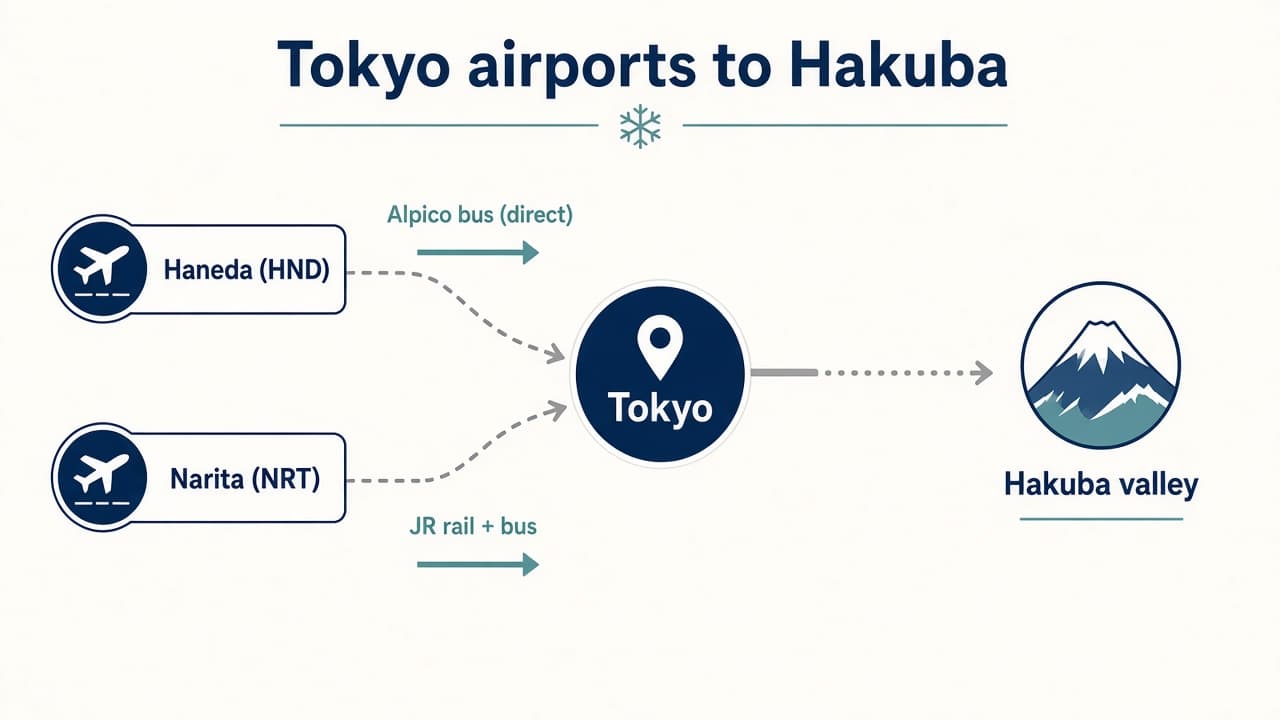
From Haneda: the airport bus to Busta Shinjuku for the Hakuba bus, rail into Shinjuku for the direct Azusa train, rail to Nagano then Alpico, Nagano Snow Shuttle from Terminal 3, or drive.
From Narita: Nagano Snow Shuttle from Terminal 2, N'EX to Shinjuku then the direct Azusa train or the highway bus, or rail to Nagano then Alpico.
Take the Nagano Snow Shuttle (or a similar airport bus) from the airport: one seat, bags in the hold, and a drop-off from JR Hakuba Station to your lodge if you book it. Miss the last one and you're paying for a private transfer.
02 · Two adults, one bag, time in Tokyo
Get to Shinjuku and take the direct Azusa train or the highway bus, or rail to Nagano and Alpico (the Nagano–Hakuba bus). Compare times and fares for your day. A 7-day national JR Pass only pays if the rest of Japan is also on the itinerary. No car for the week? See Hakuba without a car for which mountains work on buses and shuttles before you pick a lodge.
03 · You will ski Cortina / cook dinners / night-hop
Tokyo hotel, bags on takkyubin (luggage forwarding) to the Hakuba lodge, the 8:00 Azusa 5 (or, in winter, the 10:02 Azusa 83) or the highway bus in the morning. Driving Narita to Hakuba at midnight jet-lagged is how people write trip reports they regret.
Direct Azusa train (Shinjuku to Hakuba)
JR East's limited express Azusa runs from Shinjuku through Matsumoto straight to JR Hakuba Station. Azusa 5 runs all year: Shinjuku 8:00, Hakuba 11:40. In winter, Azusa 83 “Hakuba Express” adds Shinjuku 10:02, Hakuba 14:10, from 19 Dec 2026 to 28 Feb 2027, every day except 2 and 3 January. All Hakuba Express seats are reserved and JR East says to book ahead. Check the destination: on 5 and 12 December and 2 and 3 January a different Azusa 83 leaves at 10:04 and terminates at Matsumoto. The Hakuba Express runs one way only, so plan the trip home separately. From Hakuba Station, ride the valley shuttle to your lodge.
Shinjuku to Hakuba: 3 hours 40 minutes on Azusa 5, 4 hours 8 minutes on Azusa 83. Add the airport-to-Shinjuku leg if you fly in.
JR fare plus a reserved-seat limited express ticket. Live price on JR East.
Best when
You are staying in Tokyo the night before
Light luggage, or skis sent ahead by takkyubin
You want no change of train and no bus terminal
Skip when
You land the same morning and cannot reach Shinjuku in time
The Hakuba Express is full on your date, or you are travelling 2 or 3 January
The Shinjuku to Hakuba highway bus runs year-round from Busta Shinjuku (Shinjuku Expressway Bus Terminal), operated jointly by Alpico and Keio Bus, to Hakuba Goryu, Hakuba-cho and Hakuba Happo Bus Terminal. Alpico publishes ¥6,400 to ¥7,800 one way, with no return fare; booking opens one month before travel. It leaves from Shinjuku, not from the airport: from Haneda the airport bus to Busta Shinjuku takes about 35 minutes. Alpico also runs Nagano to Hakuba year-round. Willer and other night buses exist; buy only from the operator or a named partner (Klook, Omio), not a random reseller. Live fares and times: alpico.co.jp.
Shinjuku to Hakuba is a half-day, traffic-dependent. Nagano to Hakuba is about an hour on the express bus.
See Alpico for this season’s fare.
Best when
You land with time to reach Shinjuku
One bag each, not a family of four plus ski bags
You want one seat, one price, no transfer at Nagano
Skip when
Late arrival that misses the last bus
Kids plus ski bags plus car seats
You refuse to walk Shinjuku highway-bus terminal with luggage
Narita: Keisei Skyliner to Ueno, or N'EX to Tokyo. Haneda: Tokyo Monorail or Keikyu into the JR network. Then Hokuriku Shinkansen to Nagano. Then Alpico Nagano-Hakuba express bus from the station forecourt. Takkyubin (Yamato luggage forwarding) Tokyo hotel to Hakuba hotel is the luggage workaround families actually use.
Airport to Happo, with a Nagano transfer, is most of a day. Ski day two.
Shinkansen plus bus is often more than a highway bus. A national JR Pass still leaves you paying the Alpico leg.
Best when
You already have a JR East or regional pass that covers Tokyo to Nagano
You want to dump bags at a Tokyo hotel first
Weather has closed the expressway and you still need a plan B
Skip when
Hakuba-only trip with no other rail
Ski bags on the Hokuriku Shinkansen at peak
You are in Shinjuku anyway: the direct Azusa is simpler
Shared bus from its counters at Haneda Terminal 3 and Narita Terminal 2 to JR Hakuba Station, 19 Dec 2026 to 14 Mar 2027 (full schedule 2 Jan to 28 Feb). Book the accommodation drop-off and you change to a smaller vehicle at the station. One checked bag and one carry-on each are free; ski and snowboard bags are ¥750 each. Book at naganosnowshuttle.com, not a random reseller. JamJam and Snowliner run similar airport transfers, so compare dates, not brand loyalty. Miss the last one and you’re buying a private car.
Half a day or more, schedule-bound, traffic and weather. Build a buffer around flight time.
Per seat, not per taxi. Live fare on naganosnowshuttle.com.
Best when
Family, ski bags, car seats, jet lag
You will not make Shinjuku in time for a bus
You want one booking from the airport to Hakuba, with an accommodation drop-off added
Skip when
Solo traveller on a budget
Flight lands after the last published shuttle, so it becomes a private transfer, which costs more
International Driving Permit (1949 Geneva) from your home auto club, in addition to your licence. Australian licence holders: get the IDP before you fly. Winter: get studless snow tyres. Chains are backup. Expressways Nagano-bound are fine until they are not, so check the overnight freeze. Parking in Happo in peak is a sport. Compare live rental quotes with winter tyres included.
Narita to Hakuba is a long expressway day. Haneda is shorter. Pick up the car after sleep, in daylight.
Rental plus ETC plus petrol plus parking. Often wins for four people. Often loses for two.
Best when
You will ski Cortina, Norikura, Sanosaka, or hop villages at night
Grocery runs with kids
You already know Japanese winter driving
Skip when
First Japan trip, no IDP, no winter-driving hours
You plan to drink in Echoland and drive back to Tsugaike
A whiteout forecast and no snow-driving experience
Operator pages only (Alpico, JR, resort lifts, ski schools). Each row has a Checked stamp and a live source link. Ranges are the operator’s published band.
Bus
Fare
Amount
Checked
Source
Alpico Nagano → Happo Bus Terminal (winter, adult one-way)
Adult one-way. Child (1–12) half. Same adult fare for Happo, Goryu, Hakuba Station, Iwatake.
Alpico / highway bus Shinjuku → Hakuba (adult one-way)
Winter adult one-way Shinjuku ↔ Hakuba area (Alpico English timetable). Night bus +¥2,000. No round-trip — buy two singles. Green-season published band is wider.
Hokuriku Shinkansen Tokyo → Nagano (adult one-way, reserved)
Ordinary reserved, normal period: base ¥4,180 + limited-express ¥4,270 (JR East Mar 2026 revision press). Unreserved ¥7,920. Busy +¥200 / peak +¥400 on the limited-express part (up to ¥8,850). Book on Ekinet for your date.
Already in Nagano from business, snow monkeys, or an overnight? Alpico (the Nagano–Hakuba express bus) is the default. About an hour from Nagano station forecourt to Happo Bus Terminal, with stops at Hakuba Station, Goryu, and Iwatake. Adult one-way is ¥3,500 (winter, checked Sep 2026). Same fare whether you get off at Hakuba Station, Happo, Goryu, or Iwatake.
There is no direct train from Nagano to Hakuba; rail means going round via Matsumoto, which is far slower than the bus. The Alpico bus is what people mean when they say “Nagano to Hakuba.”
Best when: you're in Nagano. Skip when: you're at Haneda or Narita pretending Nagano is on the way. Compare the total door-to-Hakuba time to the direct train or bus from Shinjuku, or the airport shuttle, instead.
JR Pass
A 7-day national JR Pass is often a bad buy for Tokyo to Hakuba only.
Hakuba has no shinkansen station. The shinkansen stops at Nagano, not in Hakuba. After Nagano you are on an Alpico highway bus, the Nagano–Hakuba bus. The only train with no changes is the limited express Azusa from Shinjuku to Hakuba.
A national JR Pass pays for itself on a wide Japan rail loop (Kyoto, Hiroshima, Hokkaido). It does not pay for itself on Narita or Haneda to Nagano and back, plus a Hakuba bus you still pay for.
Do the actual sum: Narita Express or Keisei Skyliner + Hokuriku Shinkansen Tokyo/Ueno to Nagano + Alpico Nagano to Hakuba, versus the direct Azusa from Shinjuku, a single highway bus or an airport shuttle van. For a Hakuba-only week the bus or shuttle usually wins on money and on luggage.
Regional passes (JR East Nagano, Hokuriku Arch, and whatever is on sale this season) can make sense if you add Matsumoto, Kanazawa, or a Tokyo-side trip. Recalculate. Do not default-buy the 7-day national pass because a blog said so in 2018.
Car rules, short
1949 Geneva IDP from your home auto club, plus your licence. Get it before you fly.
Get studless snow tyres. Chains are backup.
Do not drink in Echoland and drive to Tsugaike. The valley shuttle exists.
Questions people actually ask
How long does it take to get from Tokyo airport to Hakuba?
Half a day from either Tokyo airport, Narita or Haneda. Haneda to Shinjuku bus to Hakuba is 6–7 hours with tight connections, more often seven to eight hours with buffer. The direct Azusa train from Shinjuku takes 3 hours 40 minutes (Azusa 5) or 4 hours 8 minutes (Azusa 83), plus the airport-to-Shinjuku leg. Narita is farther and adds time. Do not plan to ski on arrival day. If you land late: Tokyo hotel, bags on takkyubin to the lodge, bus or rail in the morning.
Is there a bus from Tokyo to Hakuba?
Yes. The highway bus from Busta Shinjuku (the Shinjuku Expressway Bus Terminal) runs all year, operated jointly by Alpico and Keio Bus, and stops at Hakuba Goryu, Hakuba-cho and Hakuba Happo Bus Terminal. Alpico publishes ¥6,400 to ¥7,800 adult one way to the Hakuba area depending on the date, with no return fare. Book online from one month before you travel. From Haneda, the airport bus to Busta Shinjuku takes about 35 minutes. Nagano Snow Shuttle also runs shared buses from Haneda and Narita to JR Hakuba Station in winter.
What is the best way of getting to Hakuba from Tokyo?
Depends on your group. Two adults, one bag, time in Tokyo: a direct Azusa train from Shinjuku (Azusa 5 at 8:00 all year; in winter also Azusa 83 at 10:02), the Shinjuku highway bus, or shinkansen to Nagano then Alpico. Family with ski bags and jet lag: Nagano Snow Shuttle from the airport. You will ski Cortina and night-hop: rent a car with winter tyres. You land late: Tokyo hotel, bags on takkyubin, bus or rail in the morning. Detail and best-when/skip-when for each mode is on this page.
How do I get from Nagano to Hakuba?
Alpico express bus from Nagano station forecourt to Hakuba. About one hour to Happo Bus Terminal, with stops at Hakuba Station, Goryu, and Iwatake. Adult one-way is ¥3,500 (winter, checked Sep 2026). Same fare whether you get off at Hakuba Station, Happo, Goryu, or Iwatake. There is no direct train from Nagano to Hakuba; rail means going round via Matsumoto, so take the bus.
Should I book a 7-day JR Pass for a Hakuba trip?
Usually no if Hakuba is the whole trip. Hakuba has no shinkansen station. After Nagano you still pay Alpico. If your only rail is the direct Azusa from Shinjuku to Hakuba and back, price those two tickets against the pass. The national pass pays for itself on a wide Japan rail loop (Kyoto, Hiroshima, Hokkaido), not on Tokyo–Nagano and back. Regional passes (JR East Nagano, Hokuriku Arch) can make sense if you add Matsumoto or Kanazawa. Recalculate on the JR Pass website, then come back.